


Our team consisting of Prof. Tomasz Tasiemski, Ph.D., Piotr Urbański, Ph.D., David Feder, M.Sc., Eng., Prof. Agata Wiza, Ph.D., and Agata Korcz, Ph.D., completed a research project titled “Competency Profile of an Active Rehabilitation Instructor—Standardization of the Active Rehabilitation Foundation’s Rehabilitation Program for People with Spinal Cord Injuries” (PFRON Grant No. BEA/000076/BF/D). The project focused on evaluating the team of instructors at the Active Rehabilitation Foundation who implement a community-based rehabilitation program for people with spinal cord injuries through active rehabilitation camps.
The main objective of the project was to define the profile of an instructor in terms of practical, substantive, and social competencies. The results of the initial assessments were used to prepare and conduct three workshops aimed at improving the qualifications of instructors. Each workshop consisted of 10 training hours and 3 hours of wrap-up. A total of 94 instructors took part in the project, participating in a series of 39 hours of online workshops. Assessments of the self-care and mobility skills of instructors were conducted during active rehabilitation camps organized in 2025 and compared with the results obtained in 2023. The project utilized research tools assessing the degree of independence in activities of daily living and wheelchair mobility, as outlined in the protocol for evaluating the effectiveness of active rehablitation programs titled Inter-PEER (International Project for the Evaluation of Active Rehabilitation).
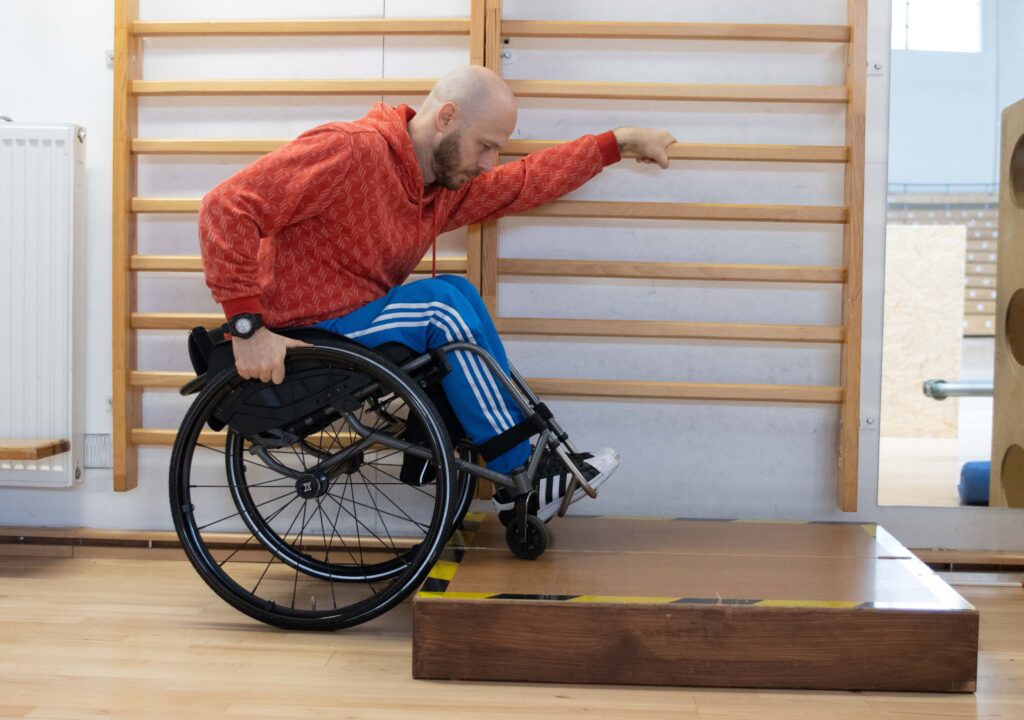
The results of the study indicate that Polish active rehabilitation instructors (individuals who have undergone spinal cord injury), who lead practical training sessions during camps, demonstrate a high level of functional independence. Their level of independence in activities of daily living and wheelchair mobility is significantly higher than that of other camp participants. These results suggest that participation in a single 10-day camp may be insufficient for many participants with spinal cord injury to achieve the functional level observed in experienced instructors. Polish instructors differ from participants with spinal cord injury in several self-care and mobility skills that are common to this group. Individuals with spinal cord injury participating in camps should undergo additional training in activities of daily living, such as transferring between a wheelchair and a car or managing a neurogenic bladder. They should also participate in additional training on advanced wheelchair mobility skills, such as maintaining balance (on the rear wheels) and navigating high curbs, in order to approach the level of self-care and mobility demonstrated by instructors.
As a result of the research, recommendations were formulated regarding the standardization of lecture topics at national camps and modifications to the training program for future instructors. The next phase of the project will involve the implementation of the proposed changes and the preparation of a scientific publication based on the project’s findings.